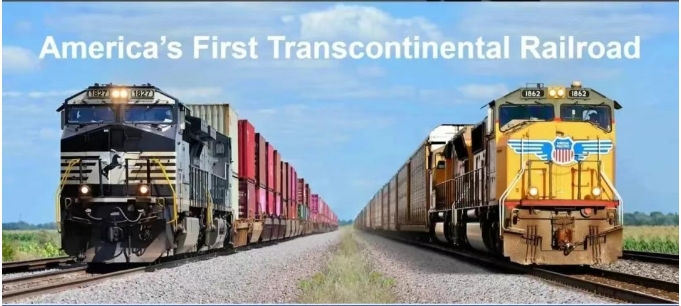
Union Pacific Corporation (NYSE: UNP) and Norfolk Southern Corporation (NYSE: NSC) today announced an agreement to create America’s first transcontinental railroad. These legendary companies will seamlessly connect over 50,000 route miles across 43 states from the East Coast to the West Coast, linking approximately 100 ports and nearly every corner of North America. This combination will transform the U.S. supply chain, unleash the industrial strength of American manufacturing, and create new sources of economic growth and workforce opportunity that preserves union jobs.
“Railroads have been an integral part of building America since the Industrial Revolution, and this transaction is the next step in advancing the industry,” said Jim Vena, Union Pacific Chief Executive Officer. “Imagine seamlessly hauling steel from Pittsburgh, Pennsylvania to Colton, California and moving tomato paste from Huron, California to Fremont, Ohio. Lumber from the Pacific Northwest, plastics from the Gulf Coast, copper from Arizona and Utah, and soda ash from Wyoming. Right now, tens of thousands of railroaders are moving almost everything we use. You name it, and at some point, the railroad hauled it.”
The Union Pacific Transcontinental Railroad will connect people, strengthen communities, and build a stronger, more competitive America. Both railroads envision every union employee who wants a job in the combined company will have one.
Together, the companies aim to be the safest railroad in North America and deliver the service customers rely on with operational excellence. The combined company will deliver faster, more comprehensive freight service to U.S. shippers by eliminating interchange delays, opening new routes, expanding intermodal services, and reducing distance and transit time on key rail corridors. A more truck-competitive solution, the Union Pacific Transcontinental Railroad will decrease highway congestion, reducing wear-and-tear on taxpayer-funded roads. Today, Union Pacific and Norfolk Southern invest approximately $5.6 billion annually in infrastructure, innovation, and network expansion.